Friday, January 23, 2015

Designing a Jacobean Fireplace continued


Mantlepiece, left side
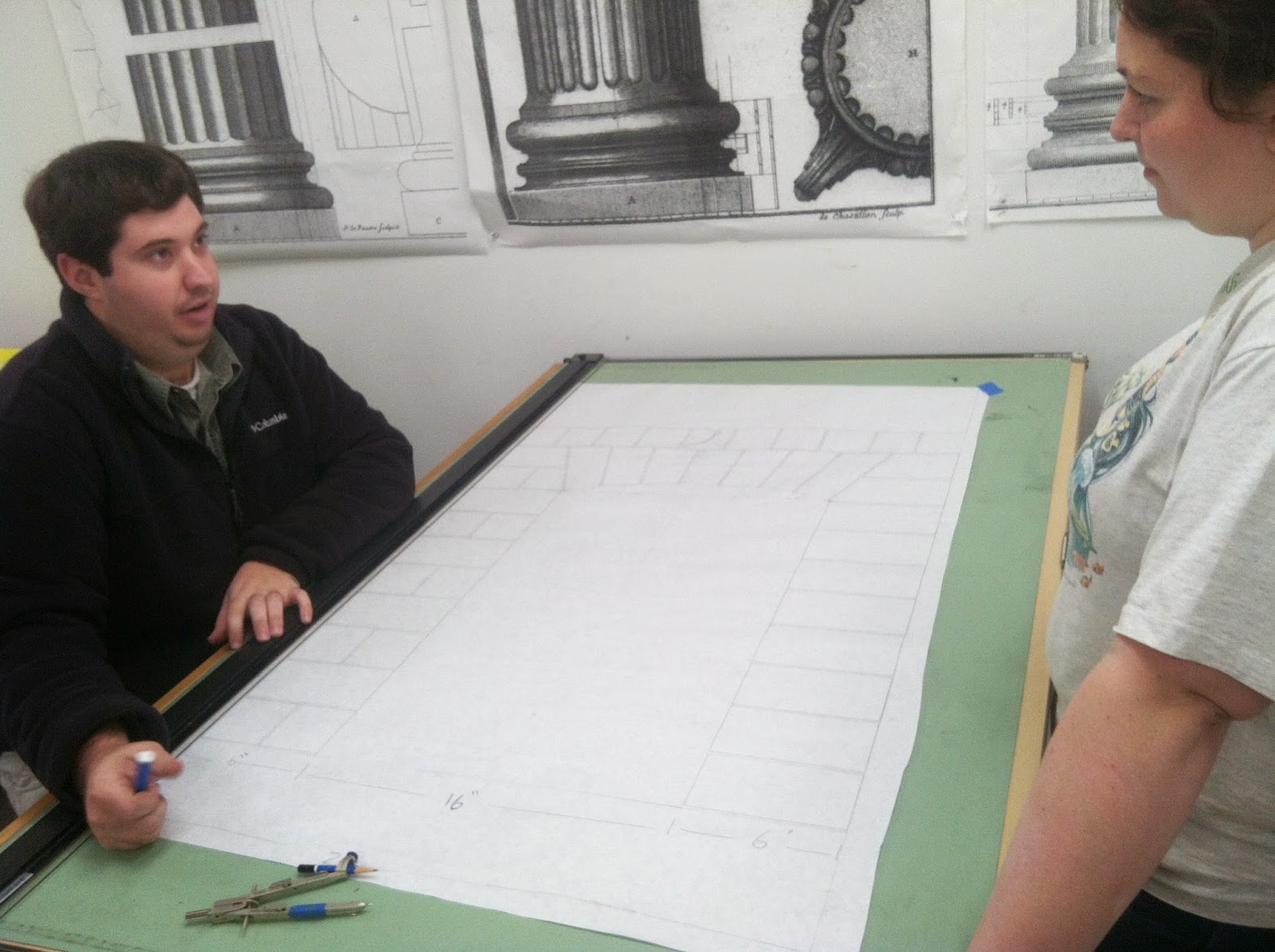
A half day was spent taking our sketches and fleshes out the details in full scale technical drawings. A review with Professor Warren resulted in some minor detail changes. I'm used to thinking of finer plaster details and stone often needs to be more robust to physically hold up to the mallet and chisel.

The redlines led to a minor cascade effect that ended up in another half day of redrawing. Better to work it out in pencil than face an issue in the stone.

Jamb profile and plinth
One of the things I've enjoyed learning in the process is the fireplace specific nomenclature. I have a fairly broad base of architectural vocabulary that didn't necessarily apply and found myself at a loss at what to call things. I believe I now have it sorted out and the pieces are labeled correctly, at least in the image captions.

Mantleshelf
Sam and I have decided to leave the spandrel and frieze areas of the mantlepiece and the concave profile of the mantleshelf solid for now, focusing on plain profile work. That way if a client is interested in the surround we can customize ornamentation for them. That won't preclude us from drawing some conceptual sketches later in the semester.

Our colleague Charles is designing an entire fireplace including the surround and firebox (and the hearth I would imagine) in brick masonry. I'm yet to discuss the details with him but it appears he is designing the surround in rubbed and gauged brick with an ovolo pattern in the mantleshelf. Exciting stuff!


Contributed by Patrick Webb

Friday, January 16, 2015

Designing a Jacobean Fireplace


Sam working on the sketch
It is the Spring semester of my Junior year and the assignment is to design and carve a limestone fireplace. My fellow student Sam and I were given the option to each produce our own small fireplace or alternatively collaborate on a more complicated design. An easy choice. We work really well together and both want to create something really special in the allotted time.

Draft of the overall design
We were conducting our research and came across this lovely fireplace from the keep of the castle in Tattershall a little to the southeast of Lincoln, UK. It appears that the fireplace was installed after 1560, squarely in the Jacobean period and the detailing is typical of the era. Sam is a talented designer and has taken the lead in the sketches you see here. We've designed it to be compatible with an Isokern Earthcore® modular firebox and are definitely on the lookout for a client. The interior width of the opening is a spacious 60". We'll be publishing details towards the end of next week.

We still have a few more details to work out including a final review of the profile and designing a small cymantium above. As with the Tattershall example we are designing the surround to fit into the wall. I think the integration conveys a deep feeling of solidity. Another attraction for us was the painted heraldry. We have 6 spaces above for ornamentation. Currently I'm researching how limestone was painted in the period and would like to incorporate similar ornamentation in the frieze, hopefully with the input of a client.


Contributed by Patrick Webb

Change You Can Believe In


Apollo and Daphne, Bernini
What you leave behind is not what is engraved on stone monuments, but what is woven into the lives of others.” ― Pericles

Metamorphosis: the changing of form of one thing into that of another. Bernini effectively captures the moment of metamorphosis of the nymph Daphne. Her pleas answered, she is transformed into a tree, escaping the lustful pursuit of the god Apollo. Yet Bernini's work too is a metamorphosis: that of a block of lifeless marble transformed into a frozen moment of movement and emotion. Underlying all of this is yet another transformation, that of the marble itself, belonging to a third or tertiary group of rock classified as Metamorphic.

Marble

Marble starts off its existence as a sedimentary rock, limestone. Through heat and pressure within the earth's crust its molecules are loosed from their bonds. Subject to magnetic forces they reorient, align becoming more crystalline. If the limestone is pure the marble will be an unadultered white such as the Luna marble used for Benini's sculpture. More often the limestone has impurities of sand, clay or other minerals that can provide interesting patterns of veining as well as a large variety of colours, many quite vibrant.

Rossa Verona marble, Basilica di Santa Maria Maggiore a Bergamo
Slate

Charleston, SC
Under certain conditions clays composed of quartz and mica will settle in sedimentary beds that later undergo compaction. These form leaves of shale, a very fissible or flaky stone not typically useful as a building material.  Under given conditions of heat and directional pressure shale will transform into slate. One of slate's most useful qualities is its impermeability of water absorption. This makes it ideal for water tables and as a roofing material. Although most slate occurs in darker colors there is still considerable variety that allow for intricate pattern making. As a result slate roofs can be quite beautiful, require minimal maintenance and often last hundreds of years. Despite its hardness and density, slate is very finely textured which makes it a desirable, enduring material for plaques and gravestones.

Quartzite
Amenhotep III, Thebes

As limestone will transform into marble, sandstone subjected to similar conditions will change into quartzite. It completely loses its original sedimentary character ending up with a very homogeneous texture. The resulting stone is typically extremely hard and likewise phenomenally durable. Quartzite is often used for paving of roads because of its character. The ancient Egyptians used quartzite for colossal monumental work. Many of their original statues have endured the elements in good condition for thousands of years.

Schist and Gneiss

Unlike the aforementioned, schist and gneiss are classifications of rocks that have undergone a geological process independent of their chemistry. They are more often than not a fusion of several different types of rock that have become subject to extreme tectonic forces, such as those occurring at continental plate boundaries. These forces causes the minerals in the rocks to separate and begin to form independent layers. Schists have varying degrees of hardness but are characterized by 'foliation' referring to fine layers that can be easily split. Gneiss by contrast is not easily split at the coarser layer boundaries and tends to be a much harder material. Gneiss is a very common material making up a large percentage of the bedrock of the earth's crust.

Gal Viharaya Buddha

That concludes this brief series on the three main classifications of rock: Igneous, Sedimentary and Metamorphic. I hope you've enjoyed them! Meanwhile, it's time for me to get back to carving. Look forward to updating you on my next project, a Jacobean fireplace in limestone.

Contributed by Patrick Webb

Monday, January 12, 2015

Sedimental Sentiments


Mary Magdalene, Titian
"Do not keep the alabaster boxes of your love and tenderness sealed up until your friends are dead. Fill their lives with sweetness, speak cheering words while their ears can hear, and while their hearts can be thrilled and made happier by them." -  William Congreve

What a great time to be a stone carver. 3 billion years ago would not have done at all. Hell on earth with nothing but pumice, granite and basalt about. If igneous rocks are the spawn of heat and flame, sedimentary stones are the progeny of water and ice. Life, erosion and lots and lots of time has mellowed, softened the waking nightmare into a dreamy paradise. 

Sedimentary stones are classified as secondary, that is to say they are the result of a subsequent action. The name 'sediment' derives from the Latin 'sedere' meaning 'to sit down' or 'deposit'. So it is that sedimentary stones form gently, layer after layer, year after year slowly accreting into laminar beds. Let's consider a few common sedimentary stones, how they form and their most appreciated properties.

Sandstone

St. John the Baptist 
Charleston, SC
Sandstone generally is a result of erosion, specifically glacial action. The ice presses forward slowly, methodically grinding the mountains of quartz, granite and feldspar, pulverizing them into sand, abandoned as they recede. Layers of sand build up, compressing under their own weight. Saturation with water is the key to turning the sand into stone. Minerals precipitate out of the water into the tiny spaces between the sand forming a natural cement. If the deposits are argillaceous, clayey the stone will remain relatively soft yet easy to carve. Calcareous deposits will produce a sandstone similar to limestone. Siliceous or silica infiltration can result in the hardest, most durable of sedimentary stones.

Limestone

The formation of limestone is typically an altogether different process of deposition. Over millions of years marine organisms small and large extract calcium from seawater to form there skeletons. As they perish, their remains collect on the ocean floor. Usually you can see 'bedding', the layers that have compacted and cemented together as clearly as rings on a tree. When cutting and laying sedimentary stone it very important to take into consideration the bedding. The stone is most vulnerable to erosion and frost if the laminar or horizontal face of the stone is exposed, particularly in a vertical orientation. Many limestones are relatively easy to work and can achieve a good level of detail making them an ideal material when learning to carve.
Students learning to carve with Indiana limestone at
The American College of the Building Arts

Alabaster

Alabaster Capital, The Breakers
Newport, RI
The most common way for gypsum to form is through the process of evaporation. As water becomes trapped in inland seas, salt levels increase exponentially. Under the right conditions, particularly when the water has high calcium content,  gypsum will precipitate in large quantities that accumulate into giant 'massifs'. As these beds compact they increasingly crystallize eventually forming the highly translucent and beautiful alabaster. Alabaster can be pure white although it is not uncommon to find a 'bloody' iron infiltration. Alabaster is a softer mineral than sandstone or limestone, is easily carved and can be brought from a lustrous to high polish.

Next we'll wrap up the series with the preferred medium of the great masters, metamorphic stone.

Contributed by Patrick Webb 

Saturday, December 20, 2014

The Gods of Rock: Pluto and Vulcan


Human beings have been working stone for a long time. It seems as though physically our hands and bodies are perfectly adapted for the task. Likewise, the ability to conceptually form stone into tools, hunting implements and structures might well be hardwired into our DNA. Such an enduring material, much of what is gleaned of early civilisation in the field of anthropology has quite literally been recorded in stone. This post initiates a three part series to shed a bit of light on the types of stones that generations of masons and carvers have found most useful. 

We Have Ignition!

We'll begin with what are called primary rocks*, so classified because they are the direct result of the original consolidation of minerals into stone. The common name for this group of stone is Igneous, derived from the Latin "Ignis" meaning "fire". That name is a strong indication of the origin of Igneous rocks, deep under the earth's surface in the lower crust or even the mantle. Oxidized silicon compounds (silicas, SiO2 or silicates, SiO4) under extreme heat and pressure form and mix  into a liquid, molten state known as magma. How that molten magma cools distinguishes the two major sub-classifications of igneous rock.

Pluto - God of the Underworld...
and Riches

Most folks know Pluto as the counterpart of the Greek Hades, the Roman god of the underworld. However, the Romans had a more positive view of Pluto also considering him the god of wealth, a giver of abundant riches. This was in no small measure due to the mineral wealth the Romans were particularly adept at unearthing from mining operations. 

Plutonic rocks are Igneous rocks that have specifically cooled, underground within the earth's crust, surrounded by other rocks. The other rocks act as a kind of insulation. As a result Plutonic rocks cool very slowly. This allows time for large and long crystal formation, resulting in a coarser textured stone. Plutonic rocks are also classified as Intrusive rocks because the magma typically "intrudes" or fills horizontal or vertical strata known as "sills" and "dikes" respectively. Larger cooled magma chambers can produce "bathotliths", huge massifs that can account for entire mountain ranges.

The most common form of Plutonic stone used for masonry is granite. Although coarse, brittle and hard to work, granite is a beautiful stone that is exceedingly durable. Because it is hard to achieve fine detail it is best reserved for large scale, monumental work when carved.

Vulcan - God of Fire...
and Volcanoes

What is not commonly known is that Vulcan was also the god of metalworking specifically and crafts in general. Most often in ancient sculpture you'll find him hammer in hand surrounded by billowing fire and smoke. The stone temples of the gods were attributed to the hands of Vulcan. 
Volcanic rocks are also Igneous rocks; however, volcanic rocks are formed from lava, magma that has been discharged from underground into the sea or in the open air. Therefore, volcanic rocks are classified as Extrusive rocks as they are "extruded" as lava from underground magma tubes onto the surface where they rapidly cool. There are many varieties of useful volcanic rock for masonry and carving. Basalt in particular shares the density and durability of granite. Yet, because of the rapid cooling, the crystalline structure basalt is much smaller and finer allowing for greater detail in carving. The Giant's Causeway on the coast of Ireland is an amazing example of a volcanic basalt formation popularized by rock gods Led Zeppelin on the iconic cover of their Houses of the Holy album.

Next in the series we'll consider my personal favourite for carving, sedimentary stone.

*The terms "rock" and "stone" are used interchangeably in this post. Some consider "rock" to denote the natural form whereas "stone" is distinguished by or set aside for human alteration.

Contributed by Patrick Webb

Wednesday, December 25, 2013

The New Apprentice


The New Apprentice
After so many years of pursuing my craft of plaster I have decided to embrace the challenge of learning an equally noble craft, architectural stone carving as a student at the American College of the Building Arts. And make no mistake my friends, it is a challenge. Whatever experience I may bring from my craft of plaster is negated by the years of acquired habits contrary to my new medium of stone. Plaster is soft, Stone is hard. Plaster is fast, Stone is slow. Plaster is additive, Stone is reductive. I'm in a bizarro world, ground zero, and my arm hurts.

Even more disconcerting, my reputation is on the line. Whilst I teach my sophomore students the art of plastering I transform later in the week into their fellow student, particularly humbling as I'm yet to especially distinguish myself as having a natural aptitude for the art of stone carving. If nothing else it has been a poignant reminder of what it is like to start from scratch and an admonition to empathize, exercise patience and be quick to recognize and praise effort or improvement. I like to think being a student is helping me to be a better teacher.

Please don't get the wrong impression. I'm actually having the time of my life. Learning alongside these young men is energizing. Being taught by a stone carver raised in the tradition of Lincoln and Wells cathedrals is a singular privilege. So what have the lads and I learned in BAAS (Building Arts Architectural Stone) 201, during the Fall semester of 2013? The following is hardly an exhaustive list but chronologically encompasses a few of the highlights:

  1. Accurately measuring the profile of an existing stone
  2. Drawing and drafting a profile
  3. Splitting a large stone by hand with plug & feathers
  4. Creating a flat surface with traditional hand tools
  5. Using a template to apply a profile to stone
  6. Carving an ovolo in a softer Texas limestone
  7. Masonry arch study
  8. Carving a cyma recta in a medium hardness Indiana limestone

Measuring and Drawing


Student tracing a profile
 from an existing piece
Accurately measuring the profile of an existing piece of stone is not as simple as you might think. With six students we initially came up with six slightly different results. Often the stone is damaged or weathered and some judgments have to be made. Methods included applying a surface profile gauge, directly measuring the individual surfaces and tracing the profile directly against a piece of paper. In the end a combination of several methods, occasionally revisited, proved to be the most accurate approach to capturing the profile.


Next we headed to the drafting studio for an exercise in shop drawing skills. Taking our measured profile for reference we imagined two turns and a stop, providing the “top bed” and all four side views, using traditional methods of hand drafted projection.

The completed shop drawing

Splitting Stone and Creating a Flat Surface
 
Student splitting
a large block of limestone
with plug and feathers
Pencils down, into the field we went. First we examined the limestone as received from the quarry, discussing the type of equipment they use to cut the stone and identifying the “bed” or natural grain resulting from the successive layers of sediment that formed the limestone, in this case from a quarry near Austin, Texas. After a number of measurements related to our original piece we proceeded to learn how to split large pieces of stone. The first step is to drill a series of holes about 6 inches apart and to a depth of approximately ½” from the base of the stone. Any closer risks a blowout on the bottom of the stone. Next, “plugs”, wedge-like piece of steel are driven between “feathers” into the holes with a steel hammer. This should be done patiently being careful to listen to the ring of the impact. A higher tone indicates a tight fit. The resulting break is surprising clean, within a ¼” accuracy on the specific Texas limestone we were working with.
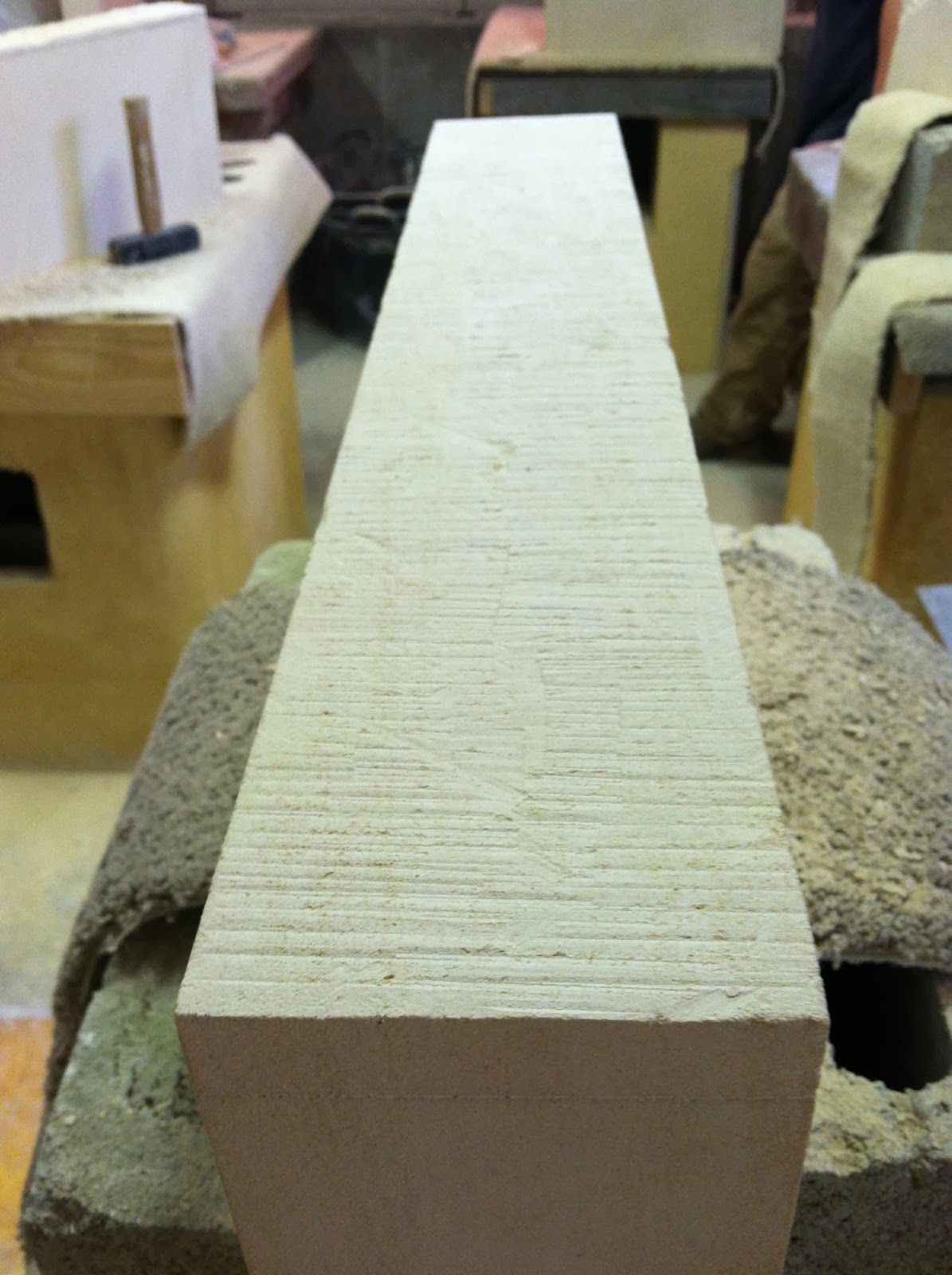

"Flatness"
Finally everything was set to begin learning stone carving in earnest. The first goal was to establish a line with a steel scribe around the stone to then cut a flat planar surface to that line. That process exposed us to the full range of hand tools. First a “pitcher” was used with a steel hammer to quickly remove large masses of stone. The steel hammer transfers considerable force into the stone. Other tools for roughing in were introduced such as the “punch” and “claw”, each removing less and less material while offering more control. Finally, as we got closer and closer to our scribed line tools for more refined work such as the “bolster” and chisels were used. These are designed to be used with a nylon mallet that absorbs much of the impact, allowing for greater precision. Frequently checking our work with a steel straight rule, we were all able to achieve the goal of a flat surface.


Student working his way to the line with a "punch"

 
Using a Template to Carve an Ovolo and Cavetto
 
The next step was both exciting and a wee bit intimidating for us all. It involved the convex ovolo curve, the concave cavetto curve as well as two inside corners. Using our previously drafted profile we cut out a template in cardboard. That was placed against the appropriate edges of the stone and scribed in with our steel point or scribe. A hard lead pencil was then sharpened and traced in the scribed lines to make the lines more easily visible. Rather than attempting to approach the curve directly we approached the ovolo gradually in as series of straight planes. 

Applying the template
Approaching completion


Masonry Arch Study and Carving a Cyma Recta


After the mid-term exam it was back to the drafting studio we participated in a preliminary study, a preview of the Spring semester goal of constructing a masonry arch. Four arches were constructed. The first two were single point or radial arches. The first of these at top left is commonly known as a “Roman” arch. Below is another radial arch integrated into an ashlar masonry façade. The top right features a three-centered arch closely resembling an ellipse in curvature. The last one at bottom right is a four-centered or Tudor arch. I'm certainly looking forward to putting this study into practice next semester.

Elliptical Arch
Roman Arch

Rusticated Roman Arch
Tudor Arch


Zinc profile
Our ultimate assignment for the semester was to carve a more complex moulding that prominently features a cyma recta or upright S-curve. This is a practical exercise as each student is assigned a piece. Together the pieces are to be used in the construction of a new sign for the college. The Indiana limestone was much harder than the previous Texas limestone. We used electrically operated grinders to cut off and flatten some of the larger sections before finishing with hand tools. As this work was to last longer and be completed outside we opted for a more durable zinc template. A progress photo is at the top of this article. Completing the moulding involves turning an outside corner and will be our first order of business in the Spring semester!

Plan and elevation for the moulding as well as a shade & shadow study

Contributed by Patrick Webb